
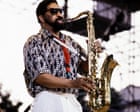
The flyers for his shows often called the saxophonist Sonny Rollins “the greatest living improviser”. On the face of it, that statement appeared to collide with the evidence, because many of the elements of a Rollins gig were repeated from one show to another.
But you had to listen beyond the themes of favourite Rollins vehicles such as St Thomas, Don’t Stop the Carnival and A Nightingale Sang in Berkeley Square to hear why he was an improvising genius whose work was revered all the way from the 1950s dives of Manhattan’s 52nd Street to the White House.
The respectful treatment of formal repertory meant little to Rollins, who has died aged 95. He loved songs and kept hundreds of tunes in his head, but those materials were merely triggers to his extraordinary spontaneous imagination and technique.
The personal nuances of improvisation meant everything to him and that was why no two Rollins performances were ever really the same. In any handful of Broadway showtunes, sketchy calypsos and torch songs, Rollins could hear the potential for spontaneous variations that would become the real material of the performance.
His improvisations would mingle dissonant and almost abstract variations with a periodically injected canny precis of the original familiar melody – like a conjuror spinning plates and racing back to the starting point to keep the faltering original in motion.
A one-time enfant terrible of jazz, Rollins gained a worldwide audience in his later years. Into his 80s, he still insisted on having no support act at his concerts and carrying an evening on his own – frequently two hours of flat-out music in which each piece would be rapidly lit on the stub of the previous one and announcements kept to a minimum in his perfunctorily charming growl.
A deceptively caressing ballad might open the show, but imperiously rolling long lines would soon burst out and turn into the big, braying acclamations, the reverberating throat-clearing slurs, the descents to floor-shaking bell-notes that were typical of him. His inner metronome was so strong that he often appeared to be pulling his bands in his wake rather than cruising on their grooves.
By the time his blood was up, the older Rollins’s bulky, shambling figure would be lurching around the stage, shrugging an emphatic left shoulder on the accents as he would always do when he was on a roll, pulling the music away from its harmonic roots so far that it would seem the connection must snap.
He was born Walter Theodore in New York. His parents, Walter, a naval steward, and Valborg (nee Solomon), originally came from the Virgin Islands, and Caribbean dance music always appealed to him. He grew up in the Sugar Hill district of Harlem with two elder siblings who studied classical music, but a sax-playing uncle who liked the blues encouraged him, and he took to the saxophone in the energetic, riff-packed “jump music” era that preceded rock’n’roll.
He learned of jump music’s saxophonist hero Louis Jordan and soon discovered the sax-playing jazz greats, admiring Coleman Hawkins’s harmonic sophistication and big, dramatic tone, Lester Young’s lyrical storytelling skills and Charlie Parker’s headlong synthesis of both. That mix of influences gave Rollins a unique combination of clout, speed, swing, song-like communicativeness and freewheeling spontaneity. The influence of the pianist Thelonious Monk, his neighbourhood friend, also sharpened his compositional skills, melodic unpredictability and instinct to subvert familiar songs.
At 18, Rollins recorded with the bebop scat-singer Babs Gonzales in 1949, following which he worked with the arranger Tadd Dameron, and then with Monk and Miles Davis for a while in the early 50s. Though he was hampered by problems with drugs and alcohol in this period, Rollins – like Davis – overcame them through concentration, self-will and a devotion to music. He joined the trumpeter Clifford Brown and the drummer Max Roach’s hard-bop group in 1956, a relationship disrupted by a fatal car accident that killed Brown and the pianist Richie Powell later that year.
By the end of that decade, Rollins had recorded some of his most enduring work, including the classic albums Saxophone Colossus (1956), Way Out West (1957) and Newk’s Time (1957). Saxophone Colossus, as well as including one of Rollins’s most energetic calypsos (St Thomas) and an imperious version of Mack the Knife, also featured a long improvisation called Blue Seven – a spontaneous stream of slurred, bleary notes, spiralling bursts of bebop powered by a steadily building intensity. It is rightly regarded as one of the great improvised jazz solos on record. Rollins did much the same on Come, Gone from Way Out West.
Rollins was prolific in this period and tunes such as Airegin, Doxy and Oleo became staple modern jazz themes. He made the jazz calypso his own, extended the potential of jazz improvising in waltz time with the original Valse Hot and stripped the sax-improv art to its bare bones by regularly working with just bass and drums on landmark recordings from Way Out West and A Night at the Village Vanguard (1957) to Freedom Suite (1958). The last of these, inspired by the civil rights movement, was a rare Rollins investigation of a longer-form work but he still sounded like an artist who valued the impromptu over the premeditated.
Though he had become one of the most respected young saxophonists, the introspective Rollins withdrew from public playing between 1959 and 1961 to improve his technique and his health. He had practised with that unbridled visionary of free jazz, Ornette Coleman, on the west coast in the 50s, and on his return began working with two key Coleman sidemen, the trumpeter Don Cherry and the drummer Billy Higgins, on music that was now looser.
Rollins recorded six albums in the three years after 1961, and The Bridge (1962) was one of the best known – named after his penchant for practising on the catwalk of the Williamsburg Bridge in New York, to avoid disturbing the neighbours at his apartment. In the 60s, he was a frequent and popular visitor to the UK, where he worked fruitfully with local house bands led by Stan Tracey at Ronnie Scott’s club in Soho, and also recorded the theme music to the film Alfie (1966), which starred Michael Caine.
Rollins’s eccentricities of dress and behaviour – taking the stage wearing raincoats or bush hats with dangling corks, or entering the club from a taxi in the street, already playing his first tune – endeared themselves to the surreally minded Scott and his circle. Concluding his show in the small hours one night, Rollins – a walking encyclopedia of popular song – was suddenly moved to recall every tune he could think of with “goodnight” in the title. According to Scott, he was still there when the cleaners were sweeping up around him at dawn.
But for all his talent, Rollins was constantly plagued with self doubt – perhaps triggered by a tension between the flying ephemerality of jazz and the solidity and permanence of the classical music his siblings had studied.
He took a second sabbatical in the late 60s – this time for five years – during which he explored music, yoga and Buddhist philosophy, on extended journeys in India and Japan. It did not make him any the less of an improviser, but he came back a more open artist.
Many of his subsequent recordings included more relaxed and sunny funk, romantic ballads and vivacious soul and calypso music. Some fans missed the more abrasive performer, but this new ease in his own skin brought Rollins a bigger audience than ever before – and his long improv odysseys still took routes even the hardcore cognoscenti could not predict.
His bands were sometimes lightweight now in comparison with the gifted stars he had worked with, but a series of albums in the 80s and 90s for the Milestone label featured plenty of soloing.
Rollins’s reputation also hit the rock mainstream when the Rolling Stones drummer Charlie Watts invited him to play on the Stones’ Waiting on a Friend in 1981. Rollins recalled that he later heard the track in a supermarket, and wondered who the horn-player was – until he remembered it was him.
In 2000, he recorded This Is What I Do with a fine group including the pianist Stephen Scott and the drummer Jack DeJohnette – with the leader applying all his old quirky power to a mix of neglected standards, some blues, a calypso and a vocal-like version of A Nightingale Sang in Berkeley Square.
A few days after the 9/11 attacks, Rollins (evacuated with his wife, Lucille, from their apartment near the World Trade Center) played a haunting concert in Boston which was released in 2005 as Without a Song: The 9/11 Concert. Lucille (nee Pearson), whom he married in 1957 and who was his manager for decades, died the year before its release. His first marriage, to Dawn Finney, had ended in divorce.
In 2006, Rollins began releasing new work on his own Doxy Records label and, in 2010, his 80th birthday was celebrated by the award of a National Medal of Arts presented by President Barack Obama, one of numerous honours that Rollins received in later life. That year there was a gala performance at the Beacon theatre in New York, featuring Rollins, Coleman and Roy Haynes, among others.
The concert was filmed by Rollins’s friend Dick Fontaine for the BBC documentary Sonny Rollins: Beyond the Notes. Reviewing the show, Nate Chinen of the New York Times described “the great unflagging sovereign of the tenor saxophone … pacing the stage in a tunic-like white shirt, his head topped by a cumulonimbus of hair”. For Chinen, he “called to mind an Old Testament prophet”.
In 2011, the former US president Bill Clinton gave the address for Rollins at the Kennedy Center Honors state dinner, declaring: “His music can bend your mind, it can break your heart and it can make you laugh out loud.” Rollins’s last live performance came the following year – having experienced respiratory problems, he had received a diagnosis of pulmonary fibrosis.
“Believe me, I tried to play for a long time before I realised I just couldn’t play any more,” Rollins told the Guardian in 2022. ‘I’ve been told there are all kinds of electric instruments I could play, but that didn’t work for me – I just wanted to blow into the horn the way Coleman Hawkins did, Charlie Parker, John Coltrane, Lester Young, all of these people that had inspired me, that’s only the way I wanted it to be. And I had that for a good portion of my life, around 70 years, and I have accepted it now … because, you know, that’s all I ever wanted to do was play.”
